
Sound familiar
The problem you’re fixing is usually not the problem you have.
“I need to post more.”
If people forget you between posts, volume isn’t the issue. Memory is. That’s a story problem, not a content problem.
“I need more traffic.”
If the people who already found you never bring anyone else, new traffic leaks out the same hole. That’s a recommendation problem, not a reach problem.
“I’m burned out.”
If you dread making the thing your audience expects, rest won’t fix it. You’ve outgrown the version of you they follow. That’s an alignment problem, not an energy problem.
“I should lower my prices.”
If buyers hesitate, price is rarely the real objection. They don’t yet know what you’re the name for. That’s a positioning problem, not a pricing problem.
Most people fix the wrong thing for six months before they figure it out. The diagnostic exists so you don’t.
Why this matters
Why do you want fans?
An audience watches you. A fandom does things for you. Here’s what that actually looks like:
And you don’t need to be famous or huge to have them — a small group who genuinely cares beats a big number that doesn’t.
They defend you
When you’re criticized or misread, fans step in on their own to set the record straight — in rooms you’re not even in.
They bring you others
They recommend and share because they believe, not because they were paid. Your growth stops depending on renting attention.
They build on your work
Fans create on top of what you make — their own takes, tools, and ideas — expanding what you offer beyond what you could build alone.
They stay
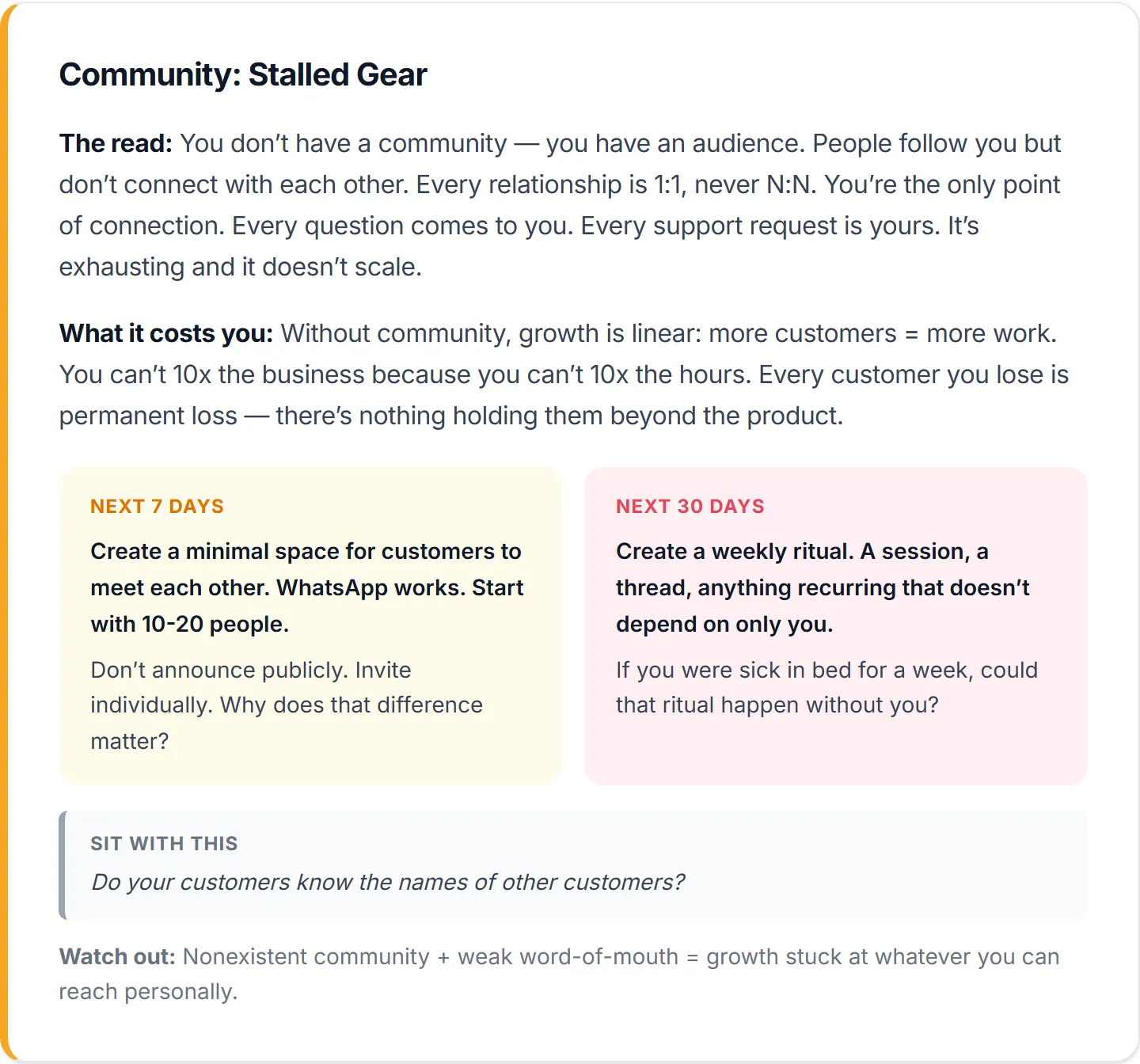
Belonging is loyalty that doesn’t chase discounts. Leaving you would mean giving up part of who they are.
They warn you early
Fans are your radar. They surface what’s shifting — new demands, new risks — long before it shows up anywhere else.
They carry each other
Fans welcome and help newcomers, so the momentum doesn’t rest entirely on you.

Where this leads
Some customers buy.
Some stay. Some carry you.
Buy once
Stick around
Recommend you
Defend you
Carry you
Most people spend years trying to get customers and almost no time on why some stay and others vanish. Some buy once and disappear. Some stick around a while. Some recommend you to a friend. Some defend you when a stranger talks shit. And some become the reason new people show up without you chasing them.
The ones that compound aren’t the ones with the most customers — they’re the ones with the most of that last group. Retention gets cheaper, referrals climb, pricing power grows, and the whole thing gets sturdier instead of more fragile. It stops being a treadmill and starts being something you own.
That’s the destination. The diagnostic just tells you where on the climb — audience, to community, to fandom — yours is stuck.

Where this came from
The people behind the biggest fandoms don’t have famous names.
They built the systems. For over a decade that was my job, inside Blizzard and Amazon: the marketing and community machines behind World of Warcraft, Overwatch, and the rebrand of Twitch Prime into Prime Gaming. The Emotion Engine is that pattern, distilled so you can run it without a billion-dollar franchise behind you.
Otavio was always a highly trusted colleague — his ability to turn even the vaguest of brand marketing’s crazy ideas into functional, real, and trackable executions is second to none. He is organized, practical, and driven — but add in years of content marketing experience, a massive mental database of pop culture and the entertainment industry, a willingness to push the envelope, and a can-do attitude. You have in Otavio one of the best resources a cutting-edge marketing team could wish for. He is Scotty to the Enterprise, and he ALWAYS has a solution.
Jon B.
Riot Games
Proof
It works for people who aren’t me.
Ertunç E.
Turkey
Joaquin M.
Spain
Kenzo H.
Japan
Chris W.
USA
See the thinking
Don’t take my word for the method. Read it.
The whole framework is written up in a short primer: the five gears, why the order is the point, and the thinking underneath the diagnostic. Read it first, then decide if you want to know which gear is yours.
Where to start
Guess free. Measure for thirty-nine. Fix it in ninety days.
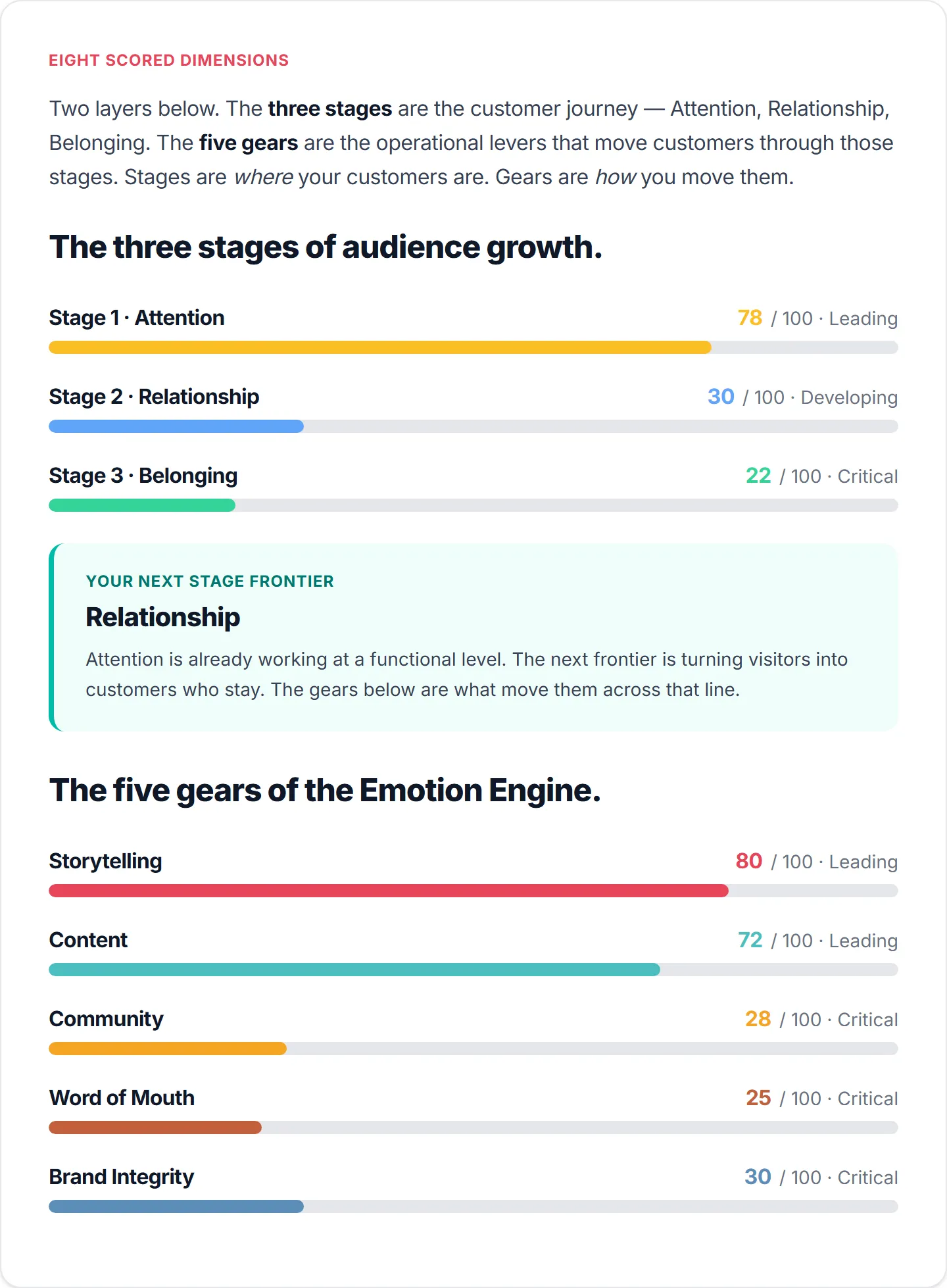
Three steps, and each one earns the next. The free read gives you a hypothesis, the Check-Up turns it into a measurement, and the Fix is the ninety days that act on it. Nobody is asked to buy the next thing before the one before it has been useful.
Find which of your five gears is likely stuck. Three minutes, fifteen questions, no signup.
Score all five gears and three stages, with the contradictions surfaced — instant.
Ninety days on that gear, then the one it was starving, then a re-measure that says whether it moved.
Want the detail on each? See how we can work together →
Questions
Before you start, the obvious ones.
Rather skip the diagnostic and just tell me what’s going on? Send a message →
I read every one and reply within 48 hours.